

The Longest Night (and the Audacity of Summer Fruit)

I need to tell you something slightly unhinged about my relationship with watermelon.
For the last few months, I’ve been in what I can only describe as a watermelon era. And not in the #FreePalestine way, although yes, that too, and always. I mean I have been obsessed. There’s always watermelon in my fridge. I’ve become that person in the produce aisle evaluating pre-sliced containers like I’m choosing a diamond. I’ve become a watermelon sommelier. “Ah yes, this one has good color saturation and optimal juice-to-seed ratio.”
I didn’t think much of it. People have phases. Some people get really into sourdough and/or opioids. I got into watermelon. Fine.
Until I started planning for Shab-e Yalda, aka the longest night of the year, and suddenly my entire watermelon situation made ancestral sense.
You know how Persians deal with the extended darkness of the winter solstice? They wage psychological warfare against it with aggressively red summer fruits. Pomegranates. Persimmons. And yes, you guessed it: watermelon. In December. When it makes absolutely no meteorological sense but makes *perfect* symbolic sense.
So now I’m sitting here wondering: what if my months-long watermelon obsession isn’t about hydration or taste at all? What if I’ve been genetically programmed for this? What if so many of my ancestors participated in this ritual that my DNA just…knows…that when it gets dark earlier and seasonal affective disorder can kick in, some ancient part of my brain goes “FETCH THE WATERMELON” and I dutifully march to the produce aisle and emerge with 5 pounds of pre-sliced summer in a plastic container?
What if I’ve been self-medicating with fruit this whole time and didn’t even realize it?
Here’s what Shab-e Yalda actually is: Tonight is the Persian winter solstice, and the centerpiece of this ancient celebration is slicing open the reddest summer fruits in the dead of winter, looking darkness straight in the face, and saying “Not today, darkness. We brought RED (snacks).”
This tradition is an old one. Older than Islam, older than the Persian Empire’s greatest hits, older than anyone’s ability to remember exactly how this started. Some ancient Zoroastrian looked at the longest night of the year and made the most relatable human decision: “Well, if we’re going to be stuck in the dark anyway, we might as well throw a party.”
The theological reasoning is actually sound. This was the night the god of light triumphed over darkness. Not through battle or drama or a celestial fistfight, but through the deeply satisfying fact of planetary physics. The sun would return because that’s literally how orbits work. But in the meantime: fruit, family, poetry, and the collective decision to eat like it’s July when it is very much not July.
Here’s my favorite part. After you’ve consumed your defiant winter watermelon, you open Hafez’s Divan, his collected poetry, to a completely random page and read whatever verse you land on as your fortune for the coming year.
No pressure or anything.
It’s like a Magic 8-Ball, except the ball is a 14th-century Sufi mystic who spent most of his career writing about wine and absolutely *roasting* religious hypocrites. The homie wrote things like “Last night I saw the angels knocking at the tavern door / They kneaded the clay of Adam and molded it into a wine cup.” He basically said “your religious leaders pray in the mosque but I found truth getting drunk with regular people,” which in medieval Shiraz was the equivalent of posting “organized religion is a scam, actually” on main.
The verses are never straightforward though. You’re asking practical questions about your actual life and Hafez responds with something about nightingales and rose gardens and the beloved’s hair.
So you sit there squinting at the page like you’re decoding the Da Vinci Code, trying to figure out if “the nightingale sang to the rose at dawn” means “yes, take that job” or “Maybe less screen time.”
It’s a Rorschach test disguised as poetry. You’re projecting your entire anxiety disorder onto a medieval mystic who refuses to be literal about *anything*. He’s not going to tell you what to do. He’s going to tell you about gardens and maybe throw in a wine metaphor and you have to figure it out yourself.
And somehow? This works. You find your answer in the metaphor. Or you decide the metaphor IS the answer. Or you just feel comforted that a man from 700 years ago was also confused about life and wrote beautiful things about it anyway.
This is how Persians do hope. Obliquely.
The tradition survived the Arab conquest, the Mongol invasions, multiple empires, several revolutions, and thousands of years of general human chaos. It survived because people refused to let it die. They kept gathering in the dark. They kept reading cryptic poetry to each other and nodding solemnly like it all made perfect sense. They kept insisting that eating summer fruits in winter meant something profound, even if they couldn’t quite articulate what.
So maybe my watermelon obsession isn’t random at all. Maybe it’s cellular memory. Maybe some part of me remembers what my Zoroastrian great-great-times-fifty grandmother knew: that you fight darkness with color. With sweetness. With defiance in fruit form. It’s hope you can hold in your hands and bite into.
Tonight, Iranians from Tehran to Los Tehrengeles and everywhere in between will do exactly what their ancestors did thousands of years ago: stay up too late, eat seasonally inappropriate produce, crack open Hafez to a random page and get zero help, and trust that the light comes back.
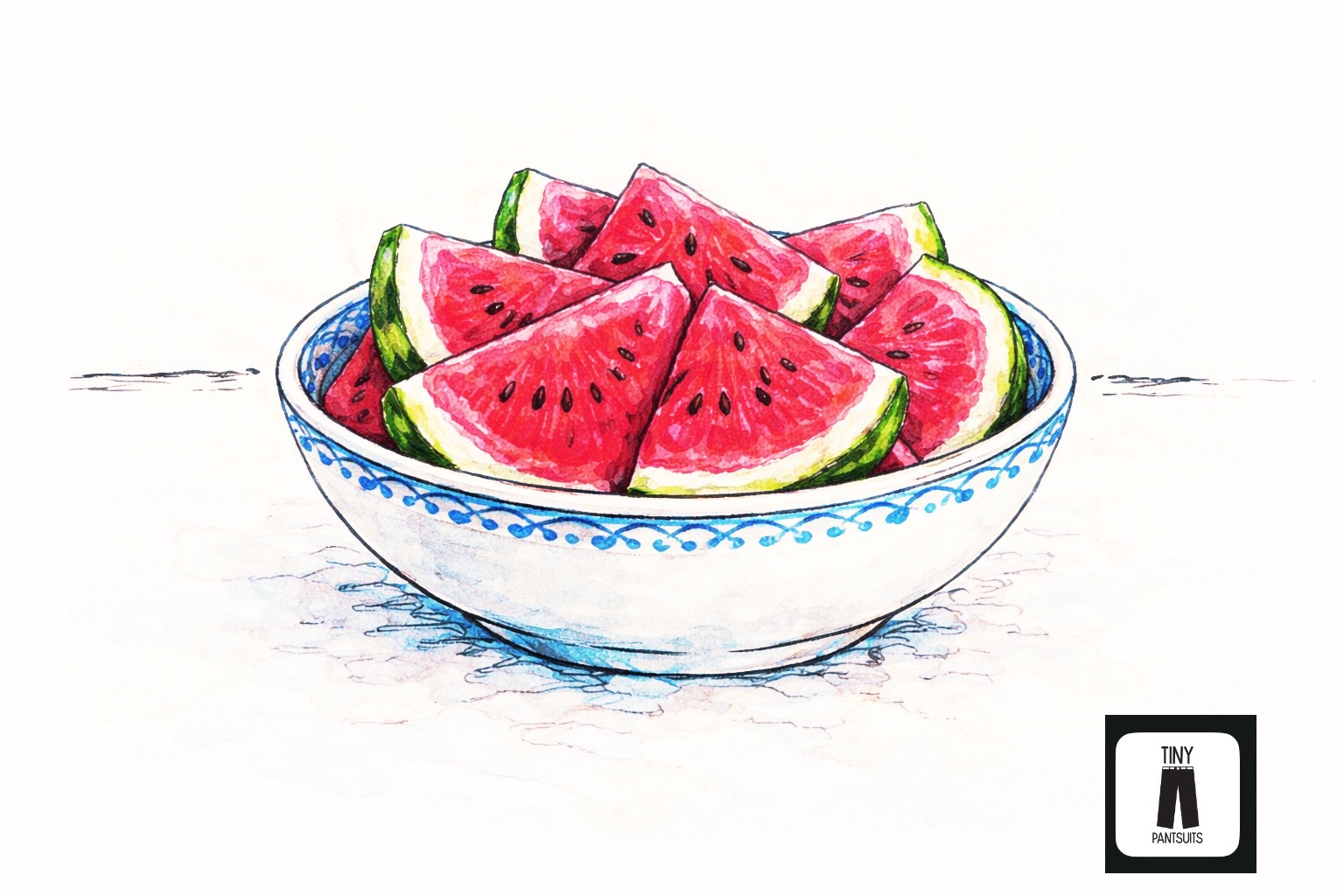
Because it always does. The planet turns whether we’re paying attention or not. The sun keeps its appointments.
So here I am, writing this before I pull out my books and my fruits, preparing to participate in a ritual older than my ability to comprehend time, finally understanding my watermelon phase for what it really was: preparation.
Even in the longest night, even when everything feels dark and uncertain, even if the sun forgot about us or was running late picking us up from night school and is now stuck in the cosmic carpool lane, we can find our colors against the darkness. We can bring our own light. Persians have had a millennia-long love affair with fire, with red, with warmth against the void.
The point is: you can slice open something red and sweet and summer-bright and remember that this isn’t forever. The light returns. It always has. It always will.
Shab-e Yalda mubarak to anyone staying up tonight. Not gonna lie, I’m not gonna make it past 12.
And to everyone else: maybe eat a watermelon this week. Or throw in extra tomatoes in your salad. Do it because people back then knew some things we are still trying to figure out. Do it because in red we trust.
The light’s coming, okay? Grab a snack.
xo,
Saana
There are other nice traditions for the longest night, too. Bonfires are one. Being with special people is another. Longest night is the real new year. Days get longer, and after winter, spring comes.